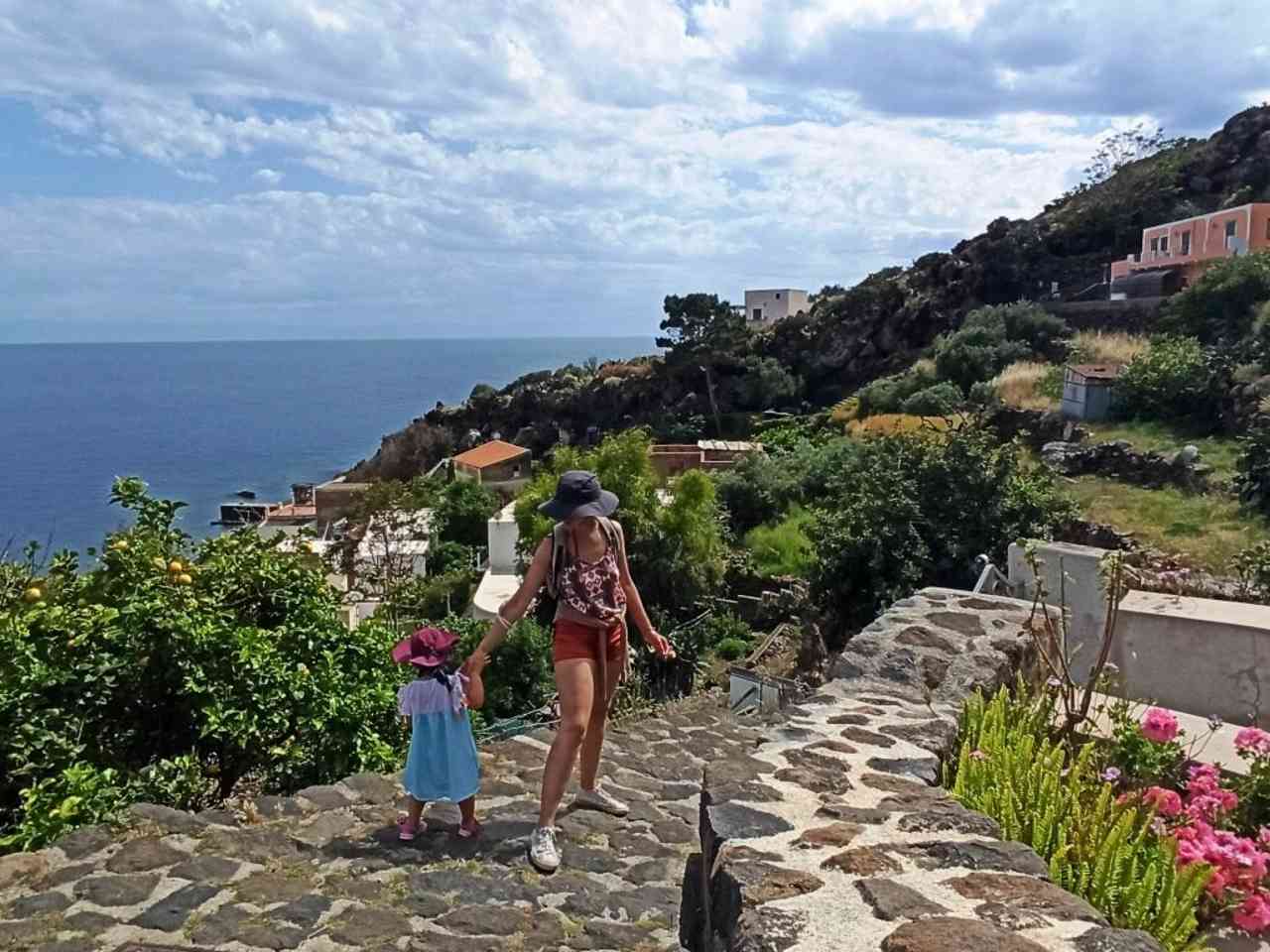
In this article today, we’ll talk about the beautiful Italian islet of Alicudi, which belongs to the Aeolian Islands archipelago, in Sicily, and administratively belongs to Lipari, an Italian municipality in the metropolitan city of Messina. In particular, however, today we’ll talk about the inhabitants of Alicudi, how many they are, and what they are called in slang.
What we know about Alicudi is that the base of the volcano extends from 1500 m below sea level to reach 675 m of Monte Filo dell’Arpa. This island is the westernmost of the entire Aeolian archipelago and is indeed the first one encountered by boats coming from Palermo or Ustica. For this reason, despite being quite rugged and isolated and despite having a total lack of coves and shelters for mooring, it has still been a reference point for all ancient navigators. The island has been inhabited since prehistoric times and in the Hellenistic age, and it still preserves some memories of the past in the remains of a settlement dating back to the early Bronze Age, 16th and 17th centuries BC, which even extended near the rock of Palumba. On the eastern coast of the island, there are also scattered ceramic fragments from the Roman period which were probably remnants of some shipwrecks.
Alicudi, like the other islands, suffered several centuries of pirate raids with raids on both the meager belongings of the poor inhabitants and the people themselves who were sold as slaves. The terror of those terrible “visits” led the inhabitants to flee and made the islet of Alicudi almost uninhabited throughout the Middle Ages, until the year 1600. As a testimony to all these tragedies remains “Il timpune delle femmine”, a name given to a steep area, particularly difficult to reach, where women and children hid during the raids of pirates and corsairs.
But how many are the inhabitants of Alicudi and what are they called?
Before answering this question, let’s continue the previous story for a moment, and we can say that the repopulation, which took place after 1600, brought to the island a small number of surnames so that, due to multiple marriages among relatives, it became really difficult to distinguish the belonging of each to their own group of origin. And from all this comes the use of so-called insults, that is, nicknames that allow the identification of individual families such as surnames of the “cavaddi” family (horses) because of the height of one of the ancestors, of the “mustazzoni” for the mustache of a great-grandfather, of the “iatti” (cats) and many others. The population of Alicudi, which currently does not even reach 150 souls, exceeded 1200 inhabitants at the beginning of the century, i.e., before the great emigrations to America and Australia. The inhabitants of this island are called “arcudari” since anciently it was known as Ericussa or Ericodes. They are a population particularly known for their physical strength and for being true “gentle giants” dedicated to fishing and agriculture, which today, however, they have somewhat neglected, as shown by the uncultivated terraces now invaded by the Mediterranean scrub, to dedicate themselves to tourists.