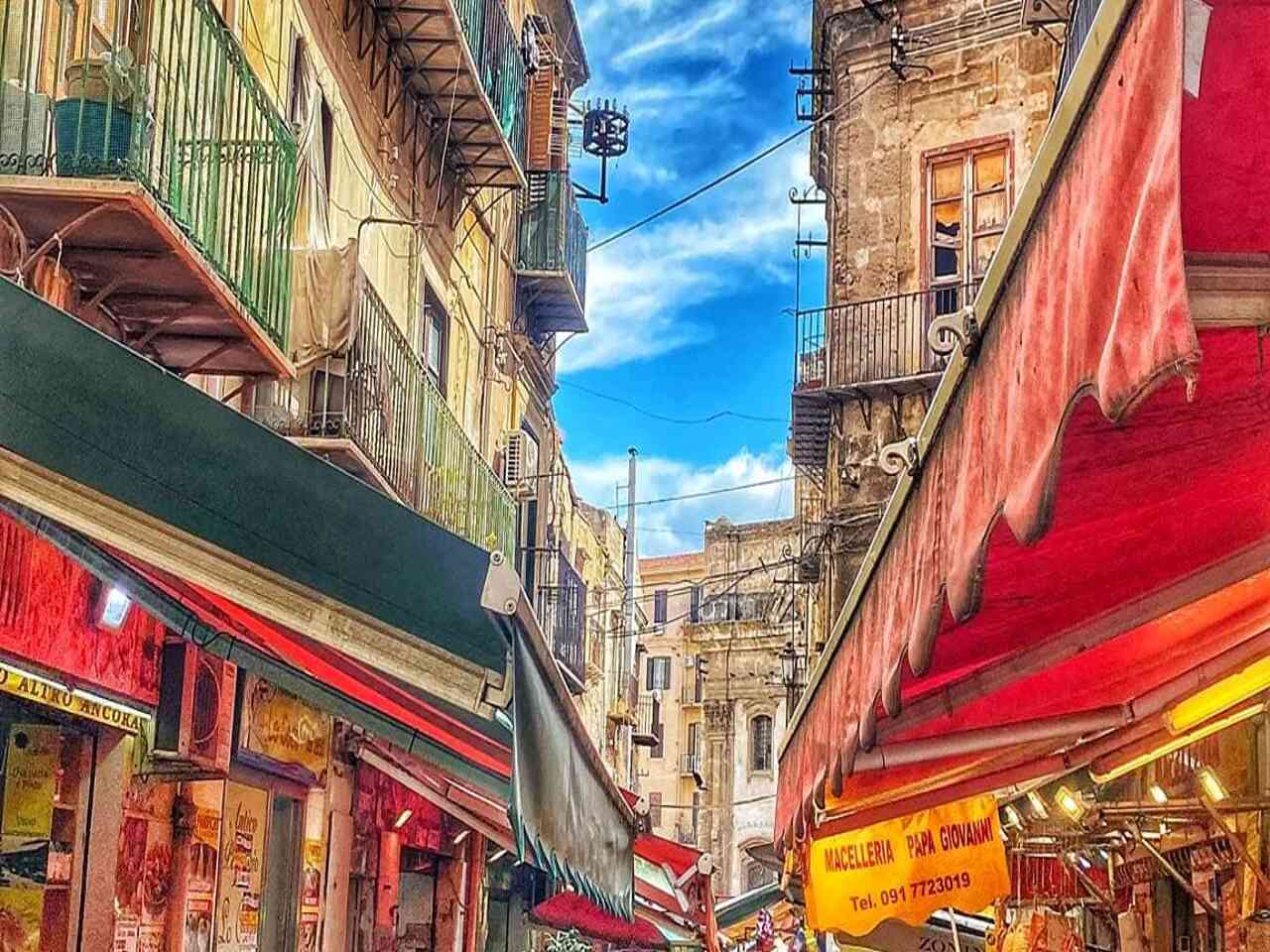
Would you like to know more about Ballarò in Palermo to visit it during a vacation in Palermo? Inside the Mandamento Palazzo Reale, bounded by Corso Tukory on one side and via Maqueda on the other, you’ll find bustling market stalls brimming with goods, spicy aromas, as well as the scents and colors of fruits and vegetables.
All the merchandise is artfully arranged, and as you pass through, you’ll hear the lively banter, the vendors’ calls to attract potential buyers. No, we’re not in an African souk but in the city of Palermo, in Ballarò, which bears significant cultural influence from the Arab presence.
The Arabs occupied Sicily in 827 AD and decided to divide the island into three valleys: Val Demone, Val di Noto, and Val di Mazara, subsequently naming the city Balarm and making it the capital of the Arab Emirate. Ballarò is the liveliest, most dynamic, and longest market in the city, its name derived from Balhara, an Islamic village near Monreale, where the vendors lived and descended daily to sell their wares at Ballarò.
It’s a “grascia” market, a term whose meaning has evolved over time; currently, it translates to “dirt,” but in the past, it referred to food, provisions.
Why should you visit Ballarò in Palermo?
Going to the market is truly delightful because you can still see the sweets that our grandmothers used to give us as snacks. Some examples are “cubbàita,” almond nougat, “cannellini,” colorful candies with cinnamon inside, “Terranova” candies with carob, and the countryside ice cream, which consists of a piece of sugar and almonds in three colors.
Moreover, what’s interesting is that in the past, during the evening, the market area would “die,” but now Piazza Ballarò shines with its own light, becoming even a youthful nightlife spot where it’s easy to find young people gathering, sipping a beer accompanied by “pani ca meusa schetto” or “maritato” (sandwich with spleen) or “pani chi panelle.”
But it doesn’t end there because in the evening, young people flock to the square and spend the evening in venues like Moltivolti, Arci Porco Rosso, Ballarak, and Santamarina Bistrot, or it also happens that tourists and citizens participate in the periodic evening openings of the monuments organized by the Terradamare Cooperative.
This area of the city also lends itself well to be embellished by street art, and indeed, several street artists in recent years have accepted the invitation to contribute artistically and socially. An illustrative example of all this is: “Si vucìa, s’abbannìa, Ballarò is magic.”
Talking about the architectural point of view, of notable interest is the Church of Carmine Maggiore, whose majolica dome, mostly blue, seems to blend seamlessly with the azure sky of Palermo. Besides this church, we also have the Oratory of Carminello, a small Serpotta jewel, and the Tower of San Nicolò, a civic quadrangular tower with marvelous mullioned windows.